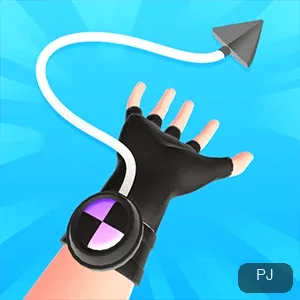
Aiming
Tap to aim at the enemy
The game's own on-screen prompt reads Tap to aim at the enemy, so combat is a tap on the target rather than a free-aim gesture. The instruction treats aiming as a deliberate moment, not a reflex.
That keeps aiming separate from the swinging. You pick a target when you have a moment, not while mid-swing. Reading the pause before you tap is the habit that makes shots count.
Levels
Level by level, with a skip
Runs are structured as numbered levels (Level 1, LEVEL 1), each beginning from a Click to start screen. The level marker on screen tells you exactly where you stand in the run.
A Skip option also appears, so a level you cannot clear is not an absolute wall. You can move past a blocker and return to the swinging instead of grinding one screen.
Items and props
Two pickup categories: items and props
The game tracks Item and Prop as separate pickup types rather than one generic collectible. Keeping them apart matters while you play, the HUD tells you which of the two you are currently holding.
They are not interchangeable, so treat a pickup as the specific thing its label names rather than any old collectible. The distinction is why the HUD keeps the two apart in the first place.
Failing
Revive, restart, or accept the fail
When a level goes wrong the game offers Revive and Restart beside a Fail state, three different exits rather than an automatic retry. You choose what happens next, and the game waits on your call.
Reviving continues the run; restarting begins the level clean. Which you take decides whether you keep the progress you had already made, so the choice is part of the strategy, not an afterthought.
Session shape
One level as the natural unit of a sitting
A session moves level to level, and each one opens from its own Click to start screen. The numbered level marker is the natural place to pause: clear one, then decide whether to continue.
Short sittings fit comfortably. One or two levels show you the swing-to-combat loop, and stopping between levels leaves nothing half-finished. Even a few minutes carries you past a level boundary.
Loading
Click to start appears after the iframe wait
Ropeman 3D runs in a portrait canvas served through a third-party iframe, and the first screen can take a visible moment to appear. A long opening usually means the build is still settling.
Reloading during the wait restarts the load and drops any progress inside the current level, so give the first screen its time. Patience here is cheaper than a second full download.
Common questions
Aiming, items, revives, and loading
How do I attack in Ropeman 3D?
Tap to aim at the enemy. That is the game's own on-screen instruction, and it treats aiming as a deliberate moment rather than a free-aim gesture.
What is the difference between Item and Prop?
They are tracked as two separate pickup types in the game's HUD, so they are not interchangeable collectibles. Treat each pickup as the specific thing its label names.
What happens if I fail a level?
The game presents Revive and Restart alongside the Fail state. Revive to continue the run, restart to begin the level clean.
Can I skip a level I am stuck on?
A Skip option appears, so a level you cannot clear is not an absolute wall; you can move past it rather than grinding the same screen.
If the page reloads mid-level, what happens?
The game reloads from scratch, a refresh during the wait restarts the load and drops any progress made inside the current level.